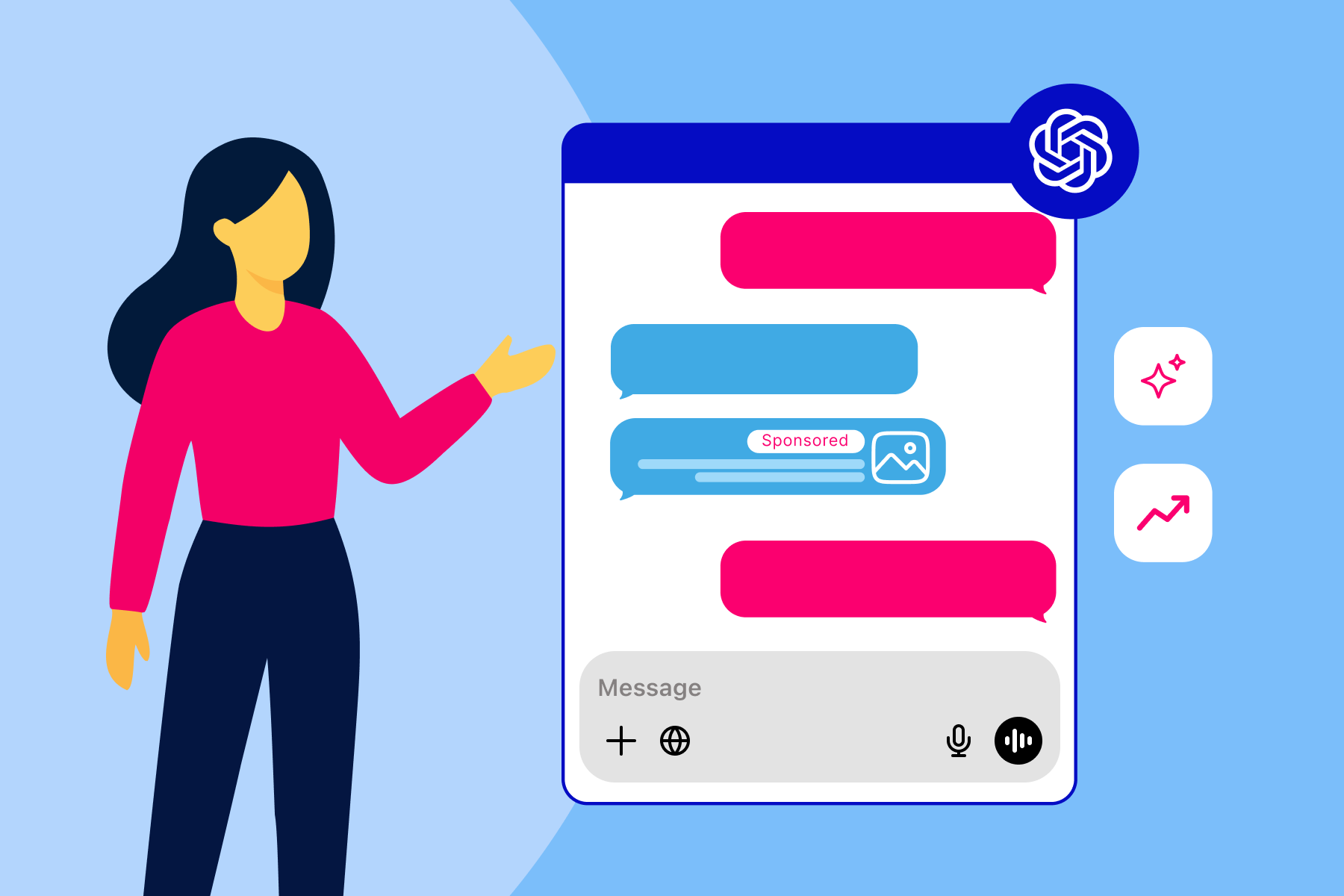
ChatGPT started showing ads on February 9, 2026, and the platform you can buy them on today looks very different from the one that launched. In under six months it went from an invitation-only pilot to a self-serve auction with CPC bidding, a conversion pixel, and a server-side API. Most of the guides currently ranking for this topic were written against the pilot, and several of them still publish character limits that will get your ads rejected.
Key Takeaways
|
This guide covers what the platform actually does right now: the real specs, the account structure that will shape how you onboard clients, the targeting mechanics in detail, and the measurement gaps you should be honest with stakeholders about. Where sources disagree, you will see that flagged rather than smoothed over.
Where ChatGPT Ads Stand in 2026
OpenAI began testing ads in the US on February 9, 2026, limited to logged-in users on the Free and Go plans. The pilot ran with a small group of advertisers before expanding through ad tech partners, and on May 5 OpenAI opened a beta self-serve Ads Manager alongside CPC bidding and expanded measurement tools. The company is targeting $2.5 billion in ad revenue this year and $100 billion by 2030, which tells you how seriously it is treating this line of business.
Commercial traction has been fast. Criteo reported in June that more than 2,000 brands were advertising on ChatGPT through its platform, and both Criteo and StackAdapt have lowered their spending minimums. The format rolled out on CPM bidding before CPC arrived, and CPC has since become the more popular of the two.
You will see a widely repeated claim that the pilot required a $200,000 minimum spend. That figure circulates almost entirely through secondary marketing blogs and does not appear in OpenAI’s own communications or in tier-one trade reporting. Treat it as unverified. What is documented is that partners have been reducing minimums and that the self-serve tier removed the barrier for smaller advertisers.
How the Placement Actually Works
A ChatGPT ad is a single sponsored card. It appears below the end of a response, is clearly labeled as sponsored, and is visually separated from the answer itself. During the test, ads do not appear in the ChatGPT Atlas browser, and they do not appear in Temporary Chats.
There is no ranking auction in the sense you know from Google. OpenAI’s own description is deliberately plain: the system starts with what is being discussed in the current chat thread, matches those topics to ads advertisers have submitted, and where multiple advertisers are eligible, shows the one most relevant to the chat first. You may see a single ad unit below a response, and that unit can feature one or more items from one advertiser or from several.
If you encounter a guide describing a named auction model with weighted relevance scoring or second-price mechanics, be skeptical. OpenAI has not published auction mechanics at that level of detail. Several confident-sounding frameworks circulating in this space appear to be invented rather than documented, and at least one site presents an entire scoring model with no basis in any OpenAI source.
Answer Independence Is a Stated Principle, Not Marketing Language
OpenAI publishes five advertising principles: mission alignment, answer independence, conversation privacy, choice and control, and long-term value. Answer independence means ads run on systems separate from the chat model, and advertisers have no ability to shape, rank, or alter responses. Seeing an ad does not mean OpenAI endorses the advertiser.
This matters for how you brief clients. Buying ChatGPT ads does nothing for how ChatGPT talks about a brand organically. Those are two different problems with two different solutions, and conflating them is the fastest way to set an expectation you cannot meet.
The Specs Most Guides Get Wrong
This is where the majority of published guidance fails. OpenAI’s Launch Campaigns documentation states the limits directly: ad titles must be 16 to 24 characters, and ad copy must be 32 to 48 characters. A great many articles, including several ranking on page one, publish 30 and 60, or 50 and 100. Ads outside the limits are rejected at review.
| Element | Requirement | Notes |
|---|---|---|
| Brand name | Required | Displayed on the card as your business name |
| Logo or favicon | Square format | Renders small; test legibility at thumbnail size |
| Ad title | 16 to 24 characters | Can truncate below the maximum depending on device |
| Ad copy | 32 to 48 characters | Should add information, not restate the title |
| Image | 256×256 pixels minimum | Square recommended; a thumbnail, not a hero image |
| Landing page URL | Live and relevant | Reviewed with the creative; mismatches are rejected |
There is no second headline, no additional description lines, and no carousel. One card, six fields. Because rendering can truncate below the stated maximums, treat 24 characters as a ceiling rather than a target and front-load the value in your title.
What 24 Characters Actually Buys You
The limits are tight enough to be worth seeing in practice. Take a hypothetical direct-to-consumer brand selling a standing desk converter, pointing at a product page rather than a homepage.
| Attempt | Title | Count |
|---|---|---|
| Too long | Adjustable Standing Desk Converter | 34, rejected |
| Fits, says nothing | Standing Desk Converter | 23 |
| Workable | Sit-Stand In One Motion | 23, states the benefit |
| Also workable | Desk Riser, No Assembly | 23, answers an objection |
The pattern to notice is that fitting the limit is easy and fitting the limit while saying something is not. A product name will usually eat the whole allowance, which forces a choice between naming the category and describing the outcome. In a conversational placement where the surrounding answer has already established the category, describing the outcome is generally the better trade.
Ad copy then carries the qualifying detail rather than repeating the title. Against the titles above, copy such as “Fits standard desks. Ships flat.” runs 32 characters and answers the two objections a reader is most likely to hold. Copy such as “The best standing desk converter” runs 32 as well and answers nothing. OpenAI’s creative guidance makes the same point in its own terms: complement the title rather than repeating it, and expand on the value rather than restating the offer.
Context Hints in Detail
Context hints are the input you control most directly, and they are where most early campaigns fail. They sit at the ad group level, formatted in the schema as a JSON array, and they describe the conversations where your ad should be eligible to appear.
OpenAI’s own framing is worth reading closely. Hints are thematic signals rather than exact keyword matching, they add context your title and copy do not already carry, and good ones are specific enough to describe a real user need while staying broad enough to absorb natural variation in how people phrase things. Critically, hints do not guarantee delivery in any particular conversation. You are briefing the system on where you would like to appear; the system decides whether you actually do.
The Mistake That Kills Most Ad Groups
The most common failure is writing hints that describe your product rather than the conversation you want to appear beside. A keyword names a string. A hint names a person in a situation.
| Weak hint | Why it fails | Stronger hint |
|---|---|---|
| project management software | Names a category, not a conversation | team missing deadlines because work is tracked across too many tools |
| running shoes | Matches shopping and trivia alike | new runner asking how to avoid shin splints on road runs |
| CRM for small business | Product-shaped, not problem-shaped | small business owner losing track of follow-ups after trade shows |
| accounting services | Too broad to signal intent | freelancer working out whether to register a company before year end |
Note the length difference between the columns. The weak side reads like a keyword list because that is what it is. The strong side reads like a sentence describing someone mid-problem, which is much closer to what an actual ChatGPT conversation looks like.
How Many Hints, and How Broad
OpenAI does not publish a recommended hint count, so what follows is Black Propeller’s working practice rather than platform documentation. Treat it as a starting position to test against rather than a rule.
Keep ad groups tightly themed. OpenAI is explicit that if you need hints covering meaningfully different products, audiences, or use cases, those belong in separate ad groups rather than combined into one. In practice that means one ad group per audience-and-intent combination, which multiplies ad groups faster than it multiplies creative. Three buyer types across two funnel stages is six ad groups, not six ads.
Within a group, a handful of hints covering the same underlying need from different angles will generally serve you better than either a single narrow hint or a long list spanning several problems. The failure modes sit at both ends: too narrow and you get no delivery, too broad and you match conversations that were never going to convert. Because you cannot see the conversations you matched against, you diagnose this from delivery volume and click-through rate rather than from a search terms report.
Campaign Objectives and Bidding
The objective structure is straightforward. Reach optimizes for impressions and bills on CPM. Clicks optimizes for clicks and bills per valid click. A conversion-optimized objective followed later, and OpenAI confirmed in late May that it would roll out from June for accounts with the pixel or Conversions API already set up.
Maximum bids sit at the ad group level, not the campaign level: a maximum CPM bid for Reach campaigns, a maximum CPC bid for Clicks campaigns. Budget, objective, dates, and country targeting sit at the campaign level above them.
On pricing, PPC Land reported a recommended range of $3 to $5 per click at the time the self-serve platform opened. Treat that as a reference point rather than a rule. It is a recommendation attached to a specific moment in a beta platform, not a system-enforced band, and auction dynamics in a market this young move quickly.
The sequencing implication matters for planning. If a client wants conversion-optimized campaigns, tracking has to be live first, because eligibility depends on it. Standing up the pixel is not a step you can defer to a later optimization phase.
Targeting: The Shift Nobody Is Covering
The standard description of ChatGPT ad targeting is that it works purely on the live conversation, with no audience uploads, no lookalikes, and no historical profiles. That was accurate at launch. It is now only half true.
OpenAI’s documentation is explicit that if a user has personalized ads enabled, ad selection can also draw on how they interact with ads, past chats, and memory, in addition to the current thread. Users can turn personalization off, in which case ads fall back to current-thread context only. The honest description is that ChatGPT ads run on conversational context by default, with an opt-out layer of behavioral personalization on top.
What you never see is the conversation itself. Advertisers receive aggregated reporting only, and never receive chats, chat history, memories, names, email addresses, precise location, IP addresses, or sensitive information. If you have built tightly themed structures in paid search, the discipline transfers even though the mechanism does not. The feedback loop does not transfer at all: there is no query report to mine.
Account Structure and the Agency Problem
This is the operational detail that will affect your onboarding process more than anything else in this guide, and it is largely absent from published coverage.
There is no manager account. Unlike Google Ads’ MCC structure, advertisers cannot view or manage multiple accounts simultaneously from a centralized interface. You can switch between accounts, but each one is accessed individually. More significantly, OpenAI is advising agencies and freelancers not to create accounts on behalf of clients.
The workflow that follows is straightforward, and it is arguably better practice anyway. The client creates the account under their own OpenAI login, completes business verification and billing under their own legal entity, and then invites your team through Settings, Users, Invite. The client owns the account, you hold revocable access, and ending an engagement means removing a seat rather than untangling ownership.
Build this into your onboarding sequence. If you assume you can spin up accounts and hand them over later, you will lose days on every new client, and some account fields cannot be changed after setup without contacting support.
The hierarchy itself will feel familiar: campaigns at the top carrying objective, budget, dates and country targeting; ad groups beneath them carrying bids and context hints; ads inside those. Each account supports up to 5,000 campaigns, 5,000 ad groups, and 5,000 ads.
Bulk Upload
Ads Manager supports guided creation in the interface and CSV bulk upload through Create, then Upload bulk. For anything beyond a handful of ad groups, bulk is the faster path, but it is unforgiving in ways worth knowing before you try it at scale.
Campaign and ad group names must match exactly across tabs with no duplicates, ad group names must be unique within a campaign, and ad names unique within their ad group. Context hints must be correctly formatted as a JSON array. Titles and copy must sit inside the character limits. OpenAI’s documentation is blunt that the system rejects any ad schema that does not exactly match its requirements, and a validation failure on a single row will typically reject the whole upload rather than the offending line.
The practical approach is to keep early batches small enough that a rejection costs you minutes rather than an afternoon, then scale batch size once a template has been through successfully.
Measurement: What Works and What Is Still Missing
OpenAI ships two measurement paths. The JavaScript measurement pixel is a browser SDK: you add the snippet to the head of your pages, initialize it with your Pixel ID, and call the measure function when a conversion happens. Alongside it, a Conversions API handles server-side event delivery, which survives ad blockers and browser storage restrictions in a way the pixel does not. There is also an Advertiser API for programmatic ad creation and performance queries.
Run both together with a shared event ID. That combination is what gives you coverage and clean deduplication at the same time. The pixel alone leaves signal on the table. Both without shared event IDs double-counts.
Now the honest part. Attribution windows and view-through methodology are not fully documented. Reporting is aggregated by design: you see views, clicks, and conversions, and you do not see user-level data, conversation content, or demographic breakdowns. That is a deliberate architectural choice tied to the conversation privacy principle, and it is not going to change.
The consequence is that ChatGPT ads will under-report their own influence, in the same way early Google and Meta measurement did. A single self-reported attribution question at the point of conversion costs almost nothing to implement and gives you a directional read on the gap between platform-reported conversions and actual channel influence. Put it in from day one rather than trying to reconstruct the picture later.
Diagnosing Zero or Low Delivery
The most common early failure on this platform is not a poor conversion rate. It is an ad group that barely delivers at all, and because there is no query report, diagnosis has to proceed by elimination. OpenAI does not publish a troubleshooting sequence, so the order below is Black Propeller’s practical working method rather than platform guidance.
Start with the things that block delivery outright rather than merely suppress it. Confirm the ads cleared review rather than sitting in a pending or rejected state. Confirm billing is complete, since campaigns will not deliver until the billing profile and payment method are both in place. Confirm your country targeting matches a market where Ads Manager is actually live.
Then check policy adjacency. Your creative can be entirely compliant and still see suppressed delivery because the conversations you are targeting sit near excluded contexts. A wellness brand writing hints around stress or sleep is describing conversations that fall close to personal health, which is an excluded placement context regardless of how clean the ad itself is. This is one of the more counterintuitive failure modes here: the ad is fine, the audience is fine, and the adjacency is the problem.
Only after those, look at the hints. Hints that are too narrow describe a conversation almost nobody is having in those words. Hints that name a product category rather than a situation give the matching system nothing to work with. Widen by describing the same need from more angles rather than by adding unrelated needs, because the second approach dilutes the group rather than expanding it.
Bid sits last in the sequence, not first. On a relevance-matched platform, raising a bid on a poorly aligned hint set does not buy delivery. If the system does not consider your ad a good fit for the conversation, the bid is not the constraint you are hitting.
Policy: What You Can and Cannot Advertise
OpenAI’s ad policies were meaningfully revised in April 2026, and guides written before that date describe a stricter regime than the one currently in force. Medical, legal, and financial advice contexts are no longer categorically blocked from ads by default, and OpenAI may approve advertisers within financial services, healthcare and medicine, and legal services on a manually reviewed, case-by-case basis.
The core allowed set during this phase remains consumer categories: household and consumer goods, local services, travel and entertainment, and digital products and education.
Disallowed at launch is a longer list than most guides reproduce. It covers adult content, alcohol and tobacco, counterfeit goods, most financial services including cryptocurrency and debt assistance, gambling, graphic sexual or violent content, most healthcare and medicine, legal services, political content, recreational drugs, scams and fraud, sensitive topics or events, and unsubstantiated wellness claims. Baseline standards apply regardless of category, including a prohibition on interface imitation: your ad cannot be designed to look like part of the ChatGPT product.
Several categories carry carve-outs worth knowing. Lingerie and swimwear can run in a standard retail context. Casino properties can advertise lodging or entertainment where gambling is not the focus. Non-intoxicating hemp products such as CBD topicals may be permitted. General wellness and fitness products can run where no medical claim is made. If a client sits near one of these lines, the carve-out is often the difference between a workable campaign and none at all.
On placement, ads are excluded from sensitive user contexts, which OpenAI defines as emotionally reliant contexts, mental and personal health conversations, and sensitive user journeys, plus a long list of brand-unsafe categories.
Enforcement is severity-tiered rather than binary. Actions range from rejecting or removing an ad, to limiting delivery, to requiring edits, to restricting account access, with suspension or termination reserved for severe, repeated, or deceptive violations. Most review runs through scaled AI systems with human oversight, with human reviewers handling borderline cases and high-severity policy areas.
The Inventory Ceiling Most Advertisers Have Not Noticed
Ads appear only for Free and Go users. Plus, Pro, Business, Enterprise, and Edu accounts do not see ads at all. Ads also do not appear in accounts where the user states or OpenAI predicts they are under 18.
Less widely noticed: Free-plan users can switch to an ads-free experience that removes ads in exchange for lower usage limits and reduced feature access, such as fewer messages and no image generation or deep research. If they hit a rate limit, ChatGPT offers them the option to switch back to the ad-supported experience for more access.
That is a genuinely interesting piece of design. It puts a price on ad exposure and gives you a structural read on your addressable audience: not all Free users, but Free users who have chosen access over an ad-free interface, plus Go subscribers. If you are modeling reach for a client, this is the constraint to factor in, and most published reach estimates currently ignore it.
Paid Placements Versus Organic AI Visibility
Because answer independence is real, buying placements does nothing for how ChatGPT describes a brand in its answers. These are separate disciplines with separate levers.
Generative engine optimization addresses the organic side: structuring content so that AI systems retrieve, understand, and cite it. It runs on content quality, technical structure, entity clarity, and external signals. Paid placements address the commercial side: reaching people at a moment of expressed intent with a specific offer.
The combination is where the leverage sits, and the logic is the one that has always applied to owning both organic and paid real estate on a results page. Someone who has just been given a substantive answer touching your category is a materially better prospect for a sponsored card than a cold impression. But you have to build both, because neither buys the other.
Platforms such as Pixis have argued for a while that the real advantage in AI-mediated advertising comes from visibility across the walled gardens rather than optimization inside any one of them. ChatGPT ads make that argument concrete: the reporting you get is deliberately thin, so whatever cross-channel picture you need, you build yourself.
Building Your First Campaign
A workable sequence, in order:
- Have the client create the advertiser account under their own login, then invite your team through Settings, Users, Invite.
- Complete business verification and add the billing profile and payment method. Campaigns will not deliver until both are done.
- Install the measurement pixel in the head of every page where conversions occur, and stand up the Conversions API with shared event IDs.
- Establish a baseline read on how ChatGPT currently describes the brand organically, so you can separate paid and organic effects later.
- Build campaigns around a single objective each, with country targeting set at campaign level.
- Build ad groups around single audience-and-intent combinations, with hints describing situations rather than product categories.
- Set maximum bids at ad group level, CPM for Reach and CPC for Clicks.
- Write titles to 16 to 24 characters and copy to 32 to 48, with multiple variants per theme and a square image at 256×256 pixels or larger.
- Confirm every landing page is live and directly matches its ad before submitting for review.
The review step is where most delays happen, and almost all of them are avoidable. Character limits and landing page mismatches are the two most common rejection causes, and both sit entirely within your control before submission.
What to Expect Next
The direction of travel is clear from the release cadence alone. In roughly four months the platform added self-serve access, CPC bidding, a pixel, a server-side API, a conversion objective, and five countries. OpenAI has said it plans to keep evolving the platform with new formats, objectives, and capabilities.
Two things are worth watching specifically. The first is whether measurement transparency improves, since the current attribution gap is the main obstacle to serious budget allocation. The second is category expansion, because OpenAI has explicitly framed the current allowed list as an early-phase constraint that will widen as its review systems mature.
What you should not assume is a smooth continuation of current pricing. Early-platform economics are early-platform economics, and 2,000-plus brands arriving through a single ad tech partner within months suggests competitive dynamics moving faster than the tooling. The argument for testing now is not that costs are permanently low. It is that the operational learning curve is real, and it is cheaper to climb at small spend than at large.
Frequently Asked Questions
Who sees ChatGPT ads?
Users on the Free and Go plans, in countries where the test is running. Plus, Pro, Business, Enterprise, and Edu accounts do not see ads. Ads also do not appear for users who state or are predicted to be under 18, in Temporary Chats, or in the ChatGPT Atlas browser during the test.
What are the real character limits?
Ad titles are 16 to 24 characters and ad copy is 32 to 48 characters, per OpenAI’s Launch Campaigns documentation. Widely republished figures of 30/60 and 50/100 are incorrect and will result in rejected ads. Real-world rendering can truncate further, so front-load your message.
What is a context hint?
A plain-language description, set at ad group level and formatted as a JSON array, of the conversations where your ad should be eligible to appear. Hints are thematic signals rather than exact keyword matches, and they do not guarantee delivery in any specific conversation. The ones that work describe a person in a situation rather than naming a product category.
Why is my ad group not delivering?
Work through it in order: approval status, billing completeness, country targeting, then policy adjacency, then hint breadth. Bid comes last, because raising a bid on a poorly matched hint set does not buy delivery on a relevance-matched platform.
Can my agency create a ChatGPT ads account for a client?
OpenAI advises against it. There is no manager account structure, and each advertiser needs its own account. The client should create and verify the account under their own identity and billing, then invite your team as users.
Do ads influence what ChatGPT says?
No. Ads run on systems separate from the chat model, and advertisers cannot shape, rank, or alter responses. OpenAI calls this answer independence and lists it among its published advertising principles.
Is targeting purely based on the current conversation?
Not entirely. By default ads match against the current chat thread, but if a user has ad personalization enabled, selection can also use past chats, memory, and prior ad interactions. Users can turn personalization off, which restricts selection to current-thread context.
Which countries can advertise?
Ads Manager is available in the United States, Canada, Australia, New Zealand, and the United Kingdom, with Japan and Korea listed as coming soon. Availability continues to change, so check OpenAI’s availability page before planning a launch.
How do I track conversions?
Install the JavaScript measurement pixel in the head of your pages and pair it with the Conversions API for server-side events, using shared event IDs to deduplicate. Attribution windows and view-through methodology are not fully documented, so treat platform-reported attribution as directional.
PakarPBN
A Private Blog Network (PBN) is a collection of websites that are controlled by a single individual or organization and used primarily to build backlinks to a “money site” in order to influence its ranking in search engines such as Google. The core idea behind a PBN is based on the importance of backlinks in Google’s ranking algorithm. Since Google views backlinks as signals of authority and trust, some website owners attempt to artificially create these signals through a controlled network of sites.
In a typical PBN setup, the owner acquires expired or aged domains that already have existing authority, backlinks, and history. These domains are rebuilt with new content and hosted separately, often using different IP addresses, hosting providers, themes, and ownership details to make them appear unrelated. Within the content published on these sites, links are strategically placed that point to the main website the owner wants to rank higher. By doing this, the owner attempts to pass link equity (also known as “link juice”) from the PBN sites to the target website.
The purpose of a PBN is to give the impression that the target website is naturally earning links from multiple independent sources. If done effectively, this can temporarily improve keyword rankings, increase organic visibility, and drive more traffic from search results.
However, using a PBN violates Google’s Webmaster Guidelines because it is considered a manipulative link scheme. Google actively works to detect and penalize such networks through algorithm updates and manual actions. If discovered, the target website may lose rankings or be removed from search results entirely. For this reason, while PBNs may offer short-term ranking gains, they carry significant long-term risks.