Your Organic Search Strategy Is Probably Missing Two Thirds of the Picture
For most of the last decade, organic visibility meant one thing: ranking on Google. Build the right pages, earn the right links, collect reviews, and traffic would follow. That framework still has a role in 2026, but if it is the only framework you are using, you are leaving a significant share of organic reach on the table.
The search experience has fractured across surfaces you may not be optimising for. 60 percent of Google searches now end without a single click, because the answer is resolved on the results page before anyone reaches your website (SparkToro via Bain, 2025). Google AI Overviews appear on roughly 13 to 16 percent of all queries and growing (Digital Applied, 2026). When they do appear, your organic click-through rate for the top-ranking result drops by 34 to 61 percent (Ahrefs and Seer Interactive, 2025). ChatGPT now has more than 900 million weekly users. Perplexity is fielding millions of queries a day. Voice assistants answer service and product questions without surfacing a results page at all.
If you have built your organic strategy entirely around ranking in traditional blue-link results, you are watching traffic decline not because your SEO got worse, but because the landscape changed around it. The opportunity is significant for businesses that understand what has replaced it.
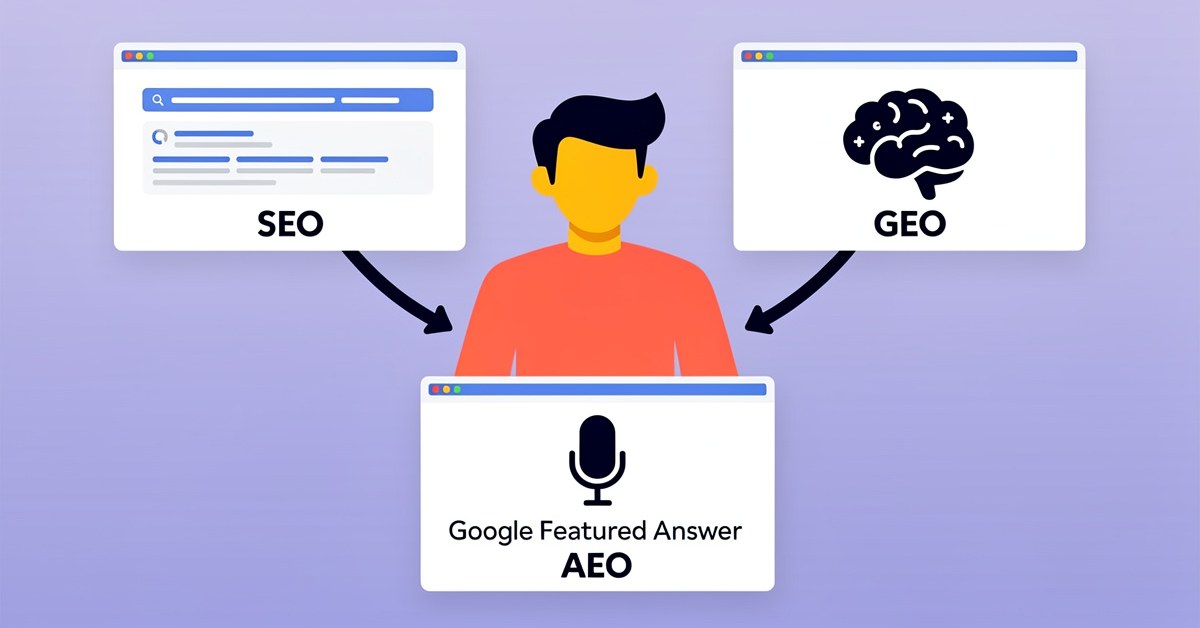
In 2026, complete organic visibility requires three coordinated disciplines. SEO gets you ranked in traditional search results. GEO (Generative Engine Optimisation) gets your brand cited in AI-generated answers. AEO (Answer Engine Optimisation) gets your specific content chosen as the direct answer in featured snippets and voice search. This guide covers all three: what they are, how they differ from each other, how they connect as a single system, and what you should do in what order.
Key Takeaways
|
Why Search Works Differently in 2026 and What It Means for You
Before getting into tactics, it helps to understand what actually changed and why a single-channel approach no longer covers the ground.
Traditional Search Is Not Dead. It Is Being Layered Over.
Google still processes roughly 5 trillion searches per year (SEO Works, 2026). The volume has not collapsed. What has changed is what happens after your customer types a query. AI Overviews, featured snippets, knowledge panels, People Also Ask boxes, and zero-click results now resolve a growing share of queries without ever sending anyone to an external website.
For informational queries such as how-to, cost, comparison, and definitions, AI Overviews reduced organic traffic to affected pages by 15 to 25 percent (SEO Works, 2026). For commercial and transactional queries, the impact is lower but growing. If your top-of-funnel content strategy is built on informational SEO traffic, you are already feeling this.
Here is the counterintuitive finding that should change your strategy: being cited inside an AI Overview produces a 35 percent lift in your organic CTR for those queries (Digital Applied, 2026). The businesses winning organic visibility right now are not those fighting the AI layer. They are those getting inside it.
AI Platforms Are Now a Distinct Traffic Source You Are Probably Ignoring
ChatGPT reached 900 million weekly users in 2026. Perplexity processes millions of queries daily. Google AI Mode routes an increasing share of complex queries through a generative experience that surfaces cited sources rather than ranked links. AI-sourced website sessions grew 527 percent year over year between 2024 and 2025 (Taylor Scher SEO, 2026). That growth rate makes AI referral traffic one of the fastest-growing organic channels available to you right now.
The detail that matters most for your strategy: 28.3 percent of the pages ChatGPT cites have zero visibility in traditional Google search (Ahrefs via Position Digital, 2026). GEO and traditional SEO are genuinely different disciplines requiring different strategies. They are not just different names for the same work.
Voice Search and Featured Answers Are a Surface You Are Probably Not Winning
Voice queries through Siri, Google Assistant, and Alexa route to featured snippets and structured answers, not ranked results pages. When your customer asks their phone for a service recommendation while driving, they hear one answer. They do not see ten blue links. 40 to 50 percent of voice search results come directly from featured snippets (The Hype Magazine, 2026). AEO is what determines whether that answer is yours.
Part 1: SEO in 2026 — What Still Works and What Has Changed
SEO remains the foundation of your organic visibility. Traditional search still accounts for the majority of organic traffic for most businesses, and the signals that determine ranking in traditional search, including relevance, authority, technical quality, and user signals, are the same signals AI systems use to evaluate which sources to trust. Getting SEO right is not just about ranking in the blue links. It is the prerequisite for everything that follows.
What Has Not Changed
The fundamentals are stable. Search engines reward content that genuinely answers what your customers are looking for, published on a technically sound site with sufficient authority. Keyword relevance, backlinks from credible sources, page speed, mobile performance, and user engagement signals all still determine your ranking. These foundations have not shifted, and any strategy that abandons them in favour of AI novelty will underperform.
What Has Changed and Why It Matters for Your Strategy
Intent classification has become significantly more important. Google in 2026 is much better at identifying whether a query wants a ranked list, a direct answer, a local result, or a transactional page. Content that does not match the dominant intent of a query will underperform against content that does, regardless of its keyword density or backlink profile. Before you write a single word, check what format Google is rewarding for that specific query and build your content to match it.
E-E-A-T (Experience, Expertise, Authoritativeness, Trustworthiness) has moved from an abstract guideline to a practical ranking differentiator, particularly in healthcare, legal, financial, and other YMYL (Your Money Your Life) categories. If your business operates in these verticals, author credentials, editorial sourcing, and first-hand experience signals are now direct ranking factors you cannot afford to ignore.
There is also a new technical SEO item that did not exist two years ago: AI crawler accessibility. Many sites inadvertently block AI crawlers through robots.txt settings or Cloudflare configurations (LLMrefs, 2026). If your site blocks GPTBot or PerplexityBot, it cannot be cited by those platforms regardless of how well your content is written. This is one of the first things to check in any technical audit.
What SEO Looks Like for Your Business Type
Local businesses including home services, healthcare, legal, and restaurants: Local SEO is your highest-ROI organic investment. Google Business Profile signals account for 32 percent of local Map Pack ranking weight (Whitespark Local Search Ranking Factors, 2026). Your GBP, service and location pages, local citations, and review generation are where you should focus first. Our local SEO service page covers the full approach for location-based businesses.
Ecommerce brands: Product page SEO, structured data for shopping results, category page optimisation, and site architecture for crawl efficiency are your priorities. AI shopping features in Google now surface products based on schema signals, making structured data more important than ever for your product visibility.
SaaS and B2B companies: Informational content targeting high-intent research queries, landing pages built around specific use cases, and thought leadership content that builds E-E-A-T signals in your category. These business types are most exposed to the AI Overview impact on informational traffic and have the most to gain from GEO. Our national SEO service covers how we approach SEO for multi-location and enterprise contexts.
You can see how SEO performance compounds alongside paid channels in our client case studies, including clients in home services, ecommerce, healthcare, and B2B technology.
Part 2: GEO (Generative Engine Optimisation) — How to Get Your Brand Cited by AI
Generative Engine Optimisation is the practice of structuring your content so that AI systems including ChatGPT, Perplexity, Google AI Overviews, and Gemini cite your brand as a trusted source when your customers ask questions related to your products, services, or category. The GEO market is growing at 45.5 percent CAGR from $1 billion in 2025 to a projected $17 billion by 2034 (Intel Market Research, 2026).
The central challenge you face with GEO is that your traditional SEO ranking is a weaker predictor of AI citation than you might expect. The overlap between top-10 Google rankings and AI Overview citations has fallen to 17 to 38 percent (BrightEdge via Mersel AI, 2026). If you rank on page one for a query, you are not guaranteed to appear in the AI Overview for that same query. GEO requires its own content signals, independent of but reinforced by strong SEO.
How AI Systems Decide What to Cite — and How to Use That to Your Advantage
Understanding the mechanics of AI citation selection is the foundation of GEO strategy. There are three mechanisms at work.
Retrieval-Augmented Generation (RAG): AI systems like Perplexity and Google AI Overviews use RAG, which means they search the web in real time, retrieve specific passages from pages, and feed those passages to the language model as context (LLMrefs, 2026). The passage that gets retrieved is the one that most directly and concisely answers the sub-query the system is resolving. If your answer is buried after a long preamble or written around a keyword rather than around a question, it will not be extracted. The implication for your content is specific: every major section needs to open with a direct answer in the first sentence, not work up to it.
Authority signals: AI systems use the same authority signals as traditional search. Domain authority, backlink quality, and brand mentions across credible sources all determine whether a source is trustworthy enough to cite. This is why building your SEO authority simultaneously builds your GEO citation eligibility. They are not competing investments.
Freshness and factual specificity: AI systems weight recent content for time-sensitive queries. Content with a visible last-updated date, current statistics with cited sources, and locally-specific or segment-specific data outperforms evergreen content without these signals (Enrich Labs, 2026). If your content makes vague general claims, it is less citeable than a competitor who makes the same point with a specific, sourced figure.
What GEO-Ready Content Looks Like in Practice
GEO-optimised content is not a separate content type from your SEO content. It is the same content written with additional structural discipline. Three areas make the difference.
Answer-first structure: The direct answer to your target question must appear in the opening sentence of the relevant section. Do not write a paragraph building up context before getting to the point. AI retrieval systems extract specific passages. If your answer is in paragraph four, it will not be extracted. This applies to every major section of every piece of content you publish.
Original data and specific claims: AI systems prefer sources that make specific, verifiable claims over sources that generalize. Content with original data, specific local figures, concrete numbers, and cited statistics is more citeable than content covering the same topic in generalities. Wherever you can include a sourced number or a locally specific fact, do it.
Entity clarity: AI systems build knowledge graphs from the content they retrieve. Your content needs to clearly establish what your business is, what it does, where it operates, and who it serves, using consistent terminology across your site and external mentions. When the system can place your brand entity confidently in the right context, it is more likely to cite you.
Across Black Propeller’s client base spanning healthcare, legal, SaaS, ecommerce, and home services, the content formats producing the most AI citations are: category-level cost guides with specific local or segment data, comparison content for high-consideration purchases, process explainers with direct sequential answers, and FAQ pages that mirror conversational queries. The Pixis agentic marketing stack analysis covers how AI platforms are evolving in their sourcing behaviour and what it means for content strategy going forward. Our GEO service page explains how we build and track AI citation performance for clients.
Tracking Your GEO Performance
26 percent of brands have zero mentions in AI Overviews in some industry snapshots (Marketing LTB, 2026), and most of them do not know it because traditional analytics tools do not capture AI visibility. Measuring your GEO performance requires monitoring brand and category citations across AI platforms directly, not just checking your Google Analytics dashboard.
Black Propeller uses Pixis Visibility to track brand citations, ranking position, and sentiment across AI engines alongside traditional Search Console data. This gives you a unified view of your organic visibility across both traditional and generative surfaces rather than flying blind on half the picture. You can also see how Pixis analyses broader shifts in how AI advertising platforms are evolving in their 2025 Google Advertising Benchmarks report.
Part 3: AEO (Answer Engine Optimisation) — How to Win the Direct Answer Position
Answer Engine Optimisation structures your content to win the single featured answer position: the snippet Google displays above all other results, the response a voice assistant reads aloud, or the direct answer box in a People Also Ask feature. Where GEO focuses on getting you cited within a longer AI-generated response, AEO focuses on getting your specific content chosen as the authoritative answer to a specific question.
The business case is straightforward. 40 to 50 percent of voice search results come from featured snippets (The Hype Magazine, 2026). When your customer asks Google Assistant for a product recommendation while cooking, or asks Siri for an emergency service at midnight, they hear one answer. The brand owning that featured position gets the call.
How AEO Differs from SEO and GEO
SEO gets you ranked in the list of results. GEO gets you cited as a source within an AI-generated summary. AEO gets you chosen as the single direct answer above everything else. All three matter and all three share the same content foundation, but AEO has the most specific structural requirements and the most immediate voice search payoff.
The AEO format that consistently wins featured snippets is: a clear question as a heading matching the exact phrasing your customers search, followed by a direct answer in the first 40 to 60 words, followed by supporting context. The opening answer is what gets extracted for voice search and featured snippets. The supporting context is what earns you the position over thinner competitors (CXL, 2026). If you write a 300-word section without a clear question heading and a direct opening answer, you are not eligible for that position regardless of how good the content is.
The Schema Markup That Makes AEO Work
Schema markup is the technical layer that connects your well-written AEO content to search engine and AI system understanding. Without it, your content can qualify for featured positions but not be reliably surfaced. The formats that matter most across business types are as follows.
FAQ schema: Apply this to any page with question-and-answer content. It creates direct eligibility for People Also Ask features, AI answer extraction, and voice search responses. Every service page, product page, and blog post covering common buyer questions should have it.
HowTo schema: Use this for step-by-step process content. It is eligible for rich results that display steps directly in search results and is used by AI systems synthesising process answers.
Article and Blog schema: This establishes your publication date, author identity, and editorial context. It reinforces your E-E-A-T signals and freshness for AI citation eligibility.
Product and Offer schema: For ecommerce brands. This surfaces your product details in AI-generated shopping responses and Google’s shopping features. If you sell products and do not have this implemented, you are invisible to a growing share of AI-assisted shopping behaviour.
LocalBusiness schema: For location-based businesses. This confirms your entity identity, location, and contact information for search engines and AI systems. Without it, AI platforms can produce conflicting information about your business across different query surfaces.
Our AEO service page covers the full schema implementation we build for clients, how we track featured snippet positions, and how we monitor voice search performance across target queries.
The Query Types Where AEO Matters Most for Your Business
Question queries: “How does X work,” “what is the best Y for Z,” “how much does W cost.” These are your highest AEO priority. Winning featured snippet positions for these queries simultaneously competes for AI Overview citations, creating overlap between your AEO and GEO strategies.
Comparison queries: “X vs Y,” “is X better than Y for Z.” Valuable for B2B, SaaS, ecommerce, and service businesses in the consideration phase. Well-structured comparison content earns featured positions and influences AI recommendations during the research phase of your customer’s decision.
Local intent queries: “Best X near me,” “X in [city],” “licensed X [city].” These are increasingly routed through voice and AI assistant rather than traditional search. Your schema, GBP optimisation, and AEO-structured location page content all contribute to winning these positions (Birdeye, 2026).
How SEO, GEO, & AEO Work Together as One System
The most important operational insight about these three disciplines is that they are not separate programmes requiring separate budgets and separate content. They share the same architecture, the same technical foundation, and the same authority signals. The distinction is in the surface they optimise for and the specific structural requirements of each.
A single well-built content piece can simultaneously rank in traditional search, earn AI citations, and win a featured snippet position. The prerequisites are a technically sound site with schema markup and confirmed AI crawler access, content structured with direct answers at the top of each section, specific verifiable claims with cited sources, and sufficient domain authority for AI systems to trust your content as a source.
When these conditions are met, the same cost guide, service page, or FAQ can rank organically for you on Google, get pulled into a ChatGPT answer when your customer asks the related question, and win the Google voice search result for the question version of the query. One piece of content, three visibility surfaces, working simultaneously.
Where They Diverge
The disciplines diverge on emphasis. SEO prioritises technical crawlability, backlink authority, and keyword intent alignment. GEO prioritises content extractability, entity clarity, and freshness signals for AI retrieval systems. AEO prioritises structural formatting and schema markup for featured snippet eligibility.
They also diverge on measurement. Your SEO success is tracked in rankings, organic impressions, and clicks from Search Console. Your GEO success is tracked in brand citation frequency, citation share, and AI platform referral sessions. Your AEO success is tracked in featured snippet positions and voice search wins. If you are only measuring one of these, you have an incomplete picture of your organic visibility.
The Build Sequence
Step 1, Technical foundation: Correct your robots.txt to permit AI crawlers, implement schema markup across key pages, confirm your Core Web Vitals pass on mobile, and fix any crawl errors. This is the prerequisite for all three disciplines. Nothing else works until this is in place.
Step 2, Content architecture: Build service and location pages for local businesses. Build product and category pages for ecommerce. Build use case and solution pages for SaaS and B2B. Each page should have answer-first section structure, FAQ schema, and locally or segment-specific data that makes it extractable.
Step 3, Authority building: Publish content consistently, earn backlinks from credible sources, generate reviews, and build external brand mentions that reinforce your entity authority across both traditional search and AI platform knowledge graphs.
Step 4, AI visibility tracking: Monitor your brand and category citations across ChatGPT, Perplexity, and Google AI Overviews. Identify gaps between where you rank and where you are cited. Use Pixis Visibility or Semrush’s AI Overview tracker to do this at scale rather than manually.
Step 5, Optimise and expand: Use your citation data and featured snippet performance to identify which content formats and topics are earning AI visibility, then build more of the same. The compound effect of a well-built organic system reduces your blended acquisition cost across the full marketing mix over time.
When this organic system runs alongside paid search, the two reinforce each other. Paid channels fill your pipeline while SEO builds. Organic leads reduce your blended CPL over time. You can see how we structure this integration on our paid search service page.
How SEO, GEO, & AEO Apply to Your Industry
The three disciplines apply across every industry, but where you focus and which content types perform best differs by vertical.
Healthcare and medical: YMYL requirements make E-E-A-T signals non-negotiable for you. Author credentials, clinical citations, and peer-reviewed sourcing are direct ranking and citation factors. Cost guides and procedure explainers are your highest-performing GEO content types because patients research these questions heavily in AI platforms before contacting anyone. FAQ schema on condition and treatment pages captures voice queries from patients in the research phase.
Legal and financial services: Informational content targeting research-phase queries is your primary organic traffic driver. These verticals are the most exposed to AI Overview impact on informational traffic, and they have the most to gain from GEO because appearing in the AI answer for a legal or financial research query is a direct source of qualified prospect contact. Your cost and comparison content, written with answer-first structure, is the highest-value GEO investment available to you right now.
Ecommerce and retail: Product schema for AI shopping features, category page optimisation for comparison queries, and cost and comparison content targeting the consideration phase are your priorities. AI-sourced shopping sessions are growing rapidly. If your product schema is not implemented, your inventory is not appearing in those results regardless of your traditional rankings.
SaaS and B2B technology: Category definition content, comparison content, and use case content addressing specific buyer problems are your core GEO assets. Your buyers are the demographic most likely to research in ChatGPT and Perplexity before shortlisting vendors, making GEO citation particularly valuable for your top-of-funnel awareness.
Home services and local businesses: Local SEO and GBP optimisation are your highest-leverage investments. Cost guides and process explainers earn you the strongest GEO citations in your market. Emergency and service query AEO captures your highest-intent voice and AI assistant searches. We cover the home services application in full depth in our home services marketing guide.
Organic Visibility Audit Checklist for SEO, GEO, & AEO
Run through this to assess where your current organic programme stands across all three disciplines.
Technical Foundation
- Your robots.txt permits GPTBot, PerplexityBot, Google-Extended, and other AI crawlers. See LLMrefs for the full crawler list.
- Schema markup (LocalBusiness, FAQ, HowTo, Article, or Product as appropriate to your business) is implemented across all key pages.
- Your Core Web Vitals pass on mobile and your site loads in under three seconds.
- There are no orphaned pages or crawl errors in your Google Search Console account.
SEO Content
- Your primary service, product, and category pages have sufficient depth, specific detail, and an intent-matched format for the queries they target.
- You have location pages (for local businesses) or use case pages (for SaaS and B2B) covering your full range of target geographies and buyer problems.
- Your backlink profile includes citations from credible industry, media, and partner sources.
- Author credentials and E-E-A-T signals are present on your content in YMYL categories.
GEO
- Every key piece of your content opens with a direct answer in the first sentence of each major section, not after a preamble.
- You have cost guides, comparison content, and FAQ pages for your highest-volume pre-purchase queries.
- Your content includes current, specific, cited statistics rather than vague generalisations.
- You have tested your brand and category queries in ChatGPT, Perplexity, and Google AI Overviews. Pixis Visibility or Semrush’s AI Overview tracker can monitor this at scale.
AEO
- FAQ schema is implemented on your service, product, and blog pages that contain question-and-answer content.
- Your FAQ section answers lead with direct responses in the first 40 to 60 words after each question heading.
- You are tracking featured snippet positions for your target question queries in Search Console.
- You have tested your key service or product queries via voice search to confirm whose answer is being returned.
Frequently Asked Questions
What is the difference between SEO, GEO, & AEO?
SEO earns you visibility in traditional ranked search results. GEO earns you citations within AI-generated answers on ChatGPT, Perplexity, and Google AI Overviews. AEO wins you the single direct answer position, the featured snippet read by voice assistants or displayed above all search results. All three build on the same content foundation but optimise for different surfaces. In 2026, a complete organic visibility strategy needs all three (Search Engine Land, 2026).
Is traditional SEO still worth investing in?
Yes. Traditional search still accounts for the majority of organic traffic and organic leads for most businesses. The change is that SEO alone no longer captures your full organic visibility potential. AI platforms and voice search now account for a significant and growing share of how your customers find you. The right response is to build GEO and AEO on top of your SEO foundation, not trade one for the others.
How quickly does GEO produce results for my business?
GEO citations can appear faster than traditional search rankings for specific queries, particularly if your domain already has authority. A well-structured cost guide or FAQ page on an established domain can earn AI citations within weeks of publication. For newer domains, GEO requires the same authority-building timeline as traditional SEO. 43.2 percent of pages ranking number one in Google are cited by ChatGPT, which means your strong SEO rankings and GEO citation eligibility are highly correlated (AirOps via Position Digital, 2026).
Do I need to create different content for SEO, GEO, & AEO?
No. The same piece of content can serve all three disciplines when it is built correctly. Direct answers at the top of each section serve GEO and AEO. Schema markup creates AEO eligibility. Sufficient depth and authority signals drive SEO ranking. The investment is in building content with all three requirements met from the start, rather than retrofitting separate pieces for each surface later.
Which businesses benefit most from GEO right now?
GEO delivers the highest immediate benefit for businesses in categories where your customers are actively using AI platforms to research before making a decision. SaaS and B2B companies whose buyers research in ChatGPT and Perplexity, healthcare and legal practices whose patients and clients ask AI for guidance before contacting anyone, and local service businesses whose customers ask AI for recommendations all have significant GEO opportunity right now. 26 percent of brands have zero AI Overview mentions in some industry snapshots (Marketing LTB, 2026). That gap is the first-mover advantage available to you.
How do I measure whether my GEO and AEO strategy is working?
Traditional analytics tools do not capture AI visibility directly. Measure GEO by testing your brand and category queries in ChatGPT, Perplexity, and Google AI Overviews, and by monitoring AI referral traffic in Google Analytics as a separate channel. Use specialist tools like Pixis Visibility or Semrush’s AI Overview tracker to do this systematically across many queries. Measure AEO by tracking featured snippet positions in Search Console, monitoring People Also Ask appearances, and testing key question queries via voice search.
Should SEO, GEO, & AEO be managed by the same agency?
The content and technical infrastructure for all three are shared, and separating them creates coordination problems that cost you visibility. An agency managing your SEO in isolation will build content that ranks but is not structured for AI extraction. An agency doing your GEO without SEO foundations will produce citeable content on a domain without the authority AI systems need to trust it as a source. Black Propeller manages all three under one integrated strategy. See our SEO, GEO, and AEO service pages for detail on each discipline and how we approach the integration.
Build Organic Visibility That Works in 2026 and Beyond
The businesses winning organic visibility in 2026 understand that search now happens across three surfaces, not one. Traditional rankings, AI-generated answers, and direct featured answers each require specific optimisation. The content, technical work, and authority signals are shared. The measurement and optimisation are surface-specific. Getting both right is the competitive advantage available to every business willing to build for all three.
Black Propeller manages SEO, GEO, & AEO as one integrated programme for clients across ecommerce, healthcare, legal, financial services, SaaS, home services, and more. Visit our SEO service page, GEO service page, and AEO service page to see how each discipline works, or contact us to discuss what an integrated organic visibility audit would look like for your business.
PakarPBN
A Private Blog Network (PBN) is a collection of websites that are controlled by a single individual or organization and used primarily to build backlinks to a “money site” in order to influence its ranking in search engines such as Google. The core idea behind a PBN is based on the importance of backlinks in Google’s ranking algorithm. Since Google views backlinks as signals of authority and trust, some website owners attempt to artificially create these signals through a controlled network of sites.
In a typical PBN setup, the owner acquires expired or aged domains that already have existing authority, backlinks, and history. These domains are rebuilt with new content and hosted separately, often using different IP addresses, hosting providers, themes, and ownership details to make them appear unrelated. Within the content published on these sites, links are strategically placed that point to the main website the owner wants to rank higher. By doing this, the owner attempts to pass link equity (also known as “link juice”) from the PBN sites to the target website.
The purpose of a PBN is to give the impression that the target website is naturally earning links from multiple independent sources. If done effectively, this can temporarily improve keyword rankings, increase organic visibility, and drive more traffic from search results.
However, using a PBN violates Google’s Webmaster Guidelines because it is considered a manipulative link scheme. Google actively works to detect and penalize such networks through algorithm updates and manual actions. If discovered, the target website may lose rankings or be removed from search results entirely. For this reason, while PBNs may offer short-term ranking gains, they carry significant long-term risks.