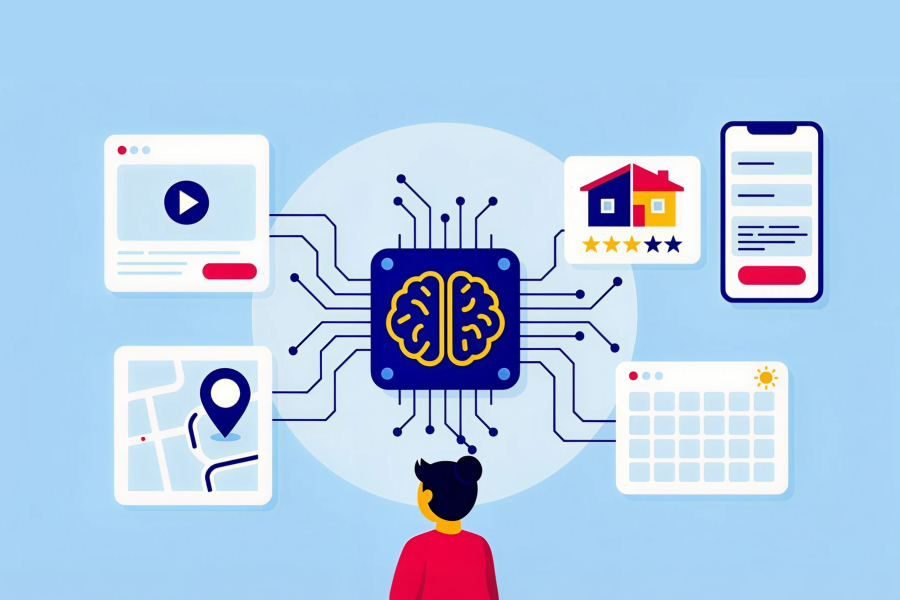
The first mistake home services businesses make with paid social is running it the same way they run Google Ads. They write an ad, set a budget, target a broad homeowner audience, and wait for the phone to ring. When it does not, they conclude that Facebook and Instagram do not work for contractors.
The problem is not the platform. It is the approach. Paid social in home services does not capture demand the way search does. A homeowner whose AC breaks down at 2pm on a Friday is not browsing Instagram looking for HVAC help. They are typing into Google. But that same homeowner spent an average of 30 to 38 minutes on Facebook per day in 2025 (Metricool, 2025) and saw your competitor’s before-and-after video last month, your five-star review ad last week, and your seasonal tune-up offer this morning. When that crisis hits, they call the brand that feels familiar.
Paid social for home services is an investment in familiarity, pipeline building, and demand capture for the jobs that are not urgent. When it is structured around the right objectives for the right job types, home services Meta Ads generate leads at $20 to $45 per lead when campaigns use a conversion objective with proper pixel tracking (Creekside Marketing, 2026). That is a CPL that justifies serious budget allocation alongside your paid search campaigns.
This guide covers everything you need to build a paid social strategy that works for your home services business: the campaign architecture, the audience structure, the creative formats that convert, the Emergency, Planned, and Seasonal framework, attribution setup, and where AI optimisation tools accelerate results. For context on how paid social fits within your full channel system, see our home services multichannel strategy guide.
Key Takeaways
|
Google Ads and Local Service Ads capture homeowners who are searching right now. Paid social captures a different audience: homeowners who will need your services in the next days, weeks, or months and have not yet entered an active search. Understanding that distinction changes how you structure campaigns, what creative you run, and what results you measure.
There are three things paid social does well for home services. First, it builds the brand familiarity that makes your search ads more effective. A homeowner who has seen your brand on Facebook and Instagram multiple times before they type your trade into Google is significantly more likely to click your ad and convert when they do. Second, it generates leads directly for planned and seasonal services where homeowners are in a consideration phase rather than a crisis mode. Third, it retargets homeowners who have already visited your website or engaged with your content, recapturing intent that paid search spent money to generate in the first place.
The platform math supports serious investment. Meta reached 3 billion monthly active users across Facebook and Instagram in 2025 (Metricool, 2025). Meta generated $196 billion in ad revenue in 2025, growing 22.1 percent year over year (2Point Agency, 2026). The platform is expanding, improving its AI targeting tools, and reaching more homeowners in more contexts than at any previous point. The contractors who are not on it are leaving that audience to competitors who are.
The strategic foundation for home services paid social is matching your campaign objective and creative approach to the type of job you are marketing for. Emergency, planned, and seasonal services require fundamentally different approaches on social.
Emergency Services: Retargeting and Brand Familiarity
For burst pipes, HVAC failure, roof leaks, and electrical faults, paid social is not your primary acquisition channel. Homeowners in an emergency are not browsing their feed. They are searching. Your primary emergency demand capture happens on Google Ads and LSAs.
The role of paid social for emergency services is retargeting: staying visible to homeowners who have already visited your website, watched your video content, or engaged with your brand. When the emergency hits, the brand they remember and trust is the one that has been in their feed. Homeowners who see retargeting ads are 70 percent more likely to convert than those who do not (Watson Co, 2026). At a fraction of the cost of acquiring a new prospect, retargeting your existing warm audience is your highest-ROI paid social investment for emergency services.
Run retargeting campaigns continuously for your emergency service lines with creative focused on trust: Google Guaranteed badge, years in business, 24/7 availability, five-star review volume. When the homeowner’s crisis arrives, these are the signals that make them call you instead of a competitor they have never heard of.
Planned Services: Demand Generation and Nurture
Kitchen and bathroom remodels, HVAC system replacements, window installations, and full landscaping projects are considered over weeks or months. Your customer is not in crisis. They are researching, comparing, and building confidence in a contractor before committing to a significant investment. This is where paid social generates leads directly, not just familiarity.
Run awareness campaigns to warm homeowner audiences with project inspiration and social proof. Follow with lead generation campaigns targeting homeowners who engaged with your awareness ads, using strong creative that combines a before-and-after project transformation with a clear offer such as a free estimate or design consultation. Use Meta Lead Ads for frictionless capture: the form opens inside Facebook or Instagram without requiring the homeowner to leave the app. Facebook Lead Ads average a 7.72 percent conversion rate at $27.66 CPL across industries (The Edigital, 2026), and home services campaigns with strong project creative and a specific offer consistently perform at or above that benchmark.
The three-campaign structure that works for planned services: an awareness campaign building brand recognition in your service area, a lead generation campaign targeting homeowners who engaged with the awareness content, and a retargeting campaign converting homeowners who visited your website but did not submit a form. This structure is detailed in Creekside Marketing’s home services Meta Ads analysis and reflects the same segmentation approach Black Propeller uses across planned-service campaigns.
Seasonal Services: Pre-Season Warming and Demand Maximisation
HVAC tune-ups, gutter cleaning, pest control, landscaping, and pressure washing all follow predictable seasonal demand curves. Your paid social strategy for seasonal services should start 4 to 6 weeks before peak season, not when demand is already high and search CPCs have already spiked.
Run social campaigns in the pre-season to build brand recognition and generate early bookings before your competitors flood paid search. Homeowners who have seen your seasonal service offer in their feed are primed to call you when they notice their gutters are overflowing or their lawn needs attention in the spring. Early bookings also give you the ability to batch schedule and improve operational efficiency, which has a direct impact on your margin during peak periods.
During peak season, increase social spend to amplify your reach and keep your brand visible alongside the higher search activity. After peak season, shift social to remarketing and educational content that keeps your brand warm through the off-season and builds the audience size you need for the next pre-season push.
The single most common reason home services paid social campaigns underdeliver is structural. Running a single campaign with a combined objective and mixed audience does not give the algorithm enough signal to optimise effectively. A properly structured home services social account runs three distinct campaigns with separate budgets, audiences, and creative.
Campaign 1: Awareness
Objective: Reach or Video Views. Audience: broad homeowner demographic in your service area. Budget: 20 to 30 percent of your total social spend. Creative: short video content (15 to 30 seconds) introducing your business, showing your team and your work, and establishing the trust signals that make homeowners feel confident before they have ever spoken to you.
This campaign does not generate direct leads. Its job is to build the audience that your lead generation and retargeting campaigns convert. Running without an awareness layer means your lower-funnel campaigns are targeting cold audiences who have never encountered your brand, which produces higher CPLs and lower conversion rates across the whole account.
Campaign 2: Lead Generation
Objective: Leads or Conversions. Audience: homeowners in your service area who engaged with your awareness content, lookalike audiences built from your customer list, or interest and demographic targeting for homeowners with recent purchase intent signals. Budget: 50 to 60 percent of your total social spend.
This is your primary lead generation campaign. Use Meta Lead Ads for planned service lines where the homeowner can submit their details without leaving Facebook or Instagram. For higher-ticket services where a phone call is the preferred conversion, run Traffic or Conversion campaigns sending homeowners to a dedicated service landing page with a visible phone number and a clear CTA. See our landing page best practices guide for the specific elements that maximise conversion rates for home services landing pages.
Campaign 3: Retargeting
Objective: Conversions or Lead generation. Audience: website visitors who did not convert, video viewers who watched 50 percent or more of your awareness content, people who interacted with your Facebook or Instagram page. Budget: 20 to 30 percent of your total social spend.
This is your highest-ROI campaign. You are spending money to re-engage homeowners who have already shown intent. Creative for retargeting should be more specific and direct than awareness content. Show the before-and-after of a recent job. Lead with your strongest review. Present a time-limited offer. The homeowner already knows who you are. Your job now is to give them a reason to act.
Audience Targeting: Reaching the Right Homeowners on Meta
Meta removed many of its explicit homeownership targeting options following privacy policy changes, but there are still multiple effective ways to reach the homeowners most likely to need your services.
Geographic Targeting
For most home services businesses, geographic precision is the most important targeting variable. There is no value in reaching a homeowner 40 miles outside your service area. Set your geographic targeting to your exact service area using zip codes rather than a radius, which gives you cleaner audience control and prevents spend on homeowners you cannot serve (Hook Agency, 2026).
Demographic and Behavioural Signals
Layer income-level targeting to reach homeowners likely to afford your service, particularly for high-ticket work like HVAC replacements, kitchen remodels, and roofing. Target by age range (homeowners skew toward 35 to 65), and use life event targeting for recent movers who are active home improvers. Homeowners who recently moved are statistically among your most valuable audiences, particularly for services like HVAC, plumbing, and landscaping.
Custom Audiences
Your most valuable targeting asset is your own customer data. Upload your customer email list to Meta to create a Custom Audience of existing customers for re-engagement and upsell campaigns. Build a website Custom Audience from your pixel data to retarget site visitors by specific pages visited. Build a video engagement audience from homeowners who watched your awareness content. Each of these custom audiences produces significantly lower CPLs than cold targeting because they have already shown some form of intent or familiarity with your brand.
Lookalike Audiences
Once you have a Custom Audience of your best customers with at least 100 to 500 records, use Meta’s Lookalike Audience feature to find homeowners who share similar characteristics. A one percent lookalike of your highest-value customer list is consistently one of the strongest performing audiences in home services social campaigns. Pixis’s AI-powered audience targeting expands on this by continuously analysing campaign performance data to discover high-value audience segments that manual targeting would miss.
Advantage+ Campaigns
Meta’s Advantage+ campaign type uses AI to automate targeting decisions, letting the algorithm find the best audiences across your entire service area without manual audience definition. Meta’s Advantage+ system has simplified campaign setup while improving results for contractors who previously struggled with manual audience configuration. For home services brands running at least $1,500 per month in social spend, testing Advantage+ against your manually targeted campaigns is worth running as a parallel experiment.
Creative is the single biggest performance variable in paid social. Two campaigns with identical targeting, budget, and structure can produce completely different CPLs based on creative quality alone. For home services, the creative formats and approaches that consistently outperform are the following.
Before-and-After Video (15 to 30 Seconds)
The most effective creative format for home services on Meta is a short video that shows the problem, the transformation, and the result. A roof before and after a replacement. A bathroom before and after a remodel. A lawn before and after a landscaping project. The visual transformation is your most powerful trust signal because it shows rather than claims. Video creative outperforms static images significantly in home services, particularly for planned high-ticket services where homeowners are evaluating the quality of your work before committing (Hook Agency, 2026). Keep the video under 30 seconds with captions, as the majority of social video is watched without sound.
A five-star review displayed prominently with a homeowner photo and a specific testimonial is one of your most credible creative assets. “Joe replaced our entire HVAC system in one day. Professional, clean, and exactly on budget. Already recommended him to three neighbors.” That type of specific, believable testimonial builds the trust that generic brand messaging cannot. Run social proof ads as part of your awareness layer and as a retargeting format for homeowners who have visited your site but have not yet converted.
Lead Form Ads with a Specific Offer
For planned services, a Lead Ad with a specific offer drives direct response. “Book your free kitchen remodel consultation before June 30 and receive a complimentary 3D design render.” Or for HVAC: “Schedule your pre-summer tune-up now and lock in last year’s price.” The offer creates urgency and specificity that a generic “contact us for a free quote” CTA cannot match. Keep the form to three to five fields maximum. Name, phone number, and the specific service they are interested in is enough to qualify the lead and follow up effectively.
Seasonal and Timely Creative
Creative tied to specific timing consistently outperforms evergreen creative for seasonal services. A gutter cleaning ad that runs in October showing a rain-filled gutter next to a clear one captures attention through relevance. An HVAC ad in April showing a hot summer day and offering to service your system before the heat arrives creates urgency that year-round creative does not. Rotate seasonal creative every 4 to 6 weeks during active periods to prevent audience fatigue.
YouTube Pre-Roll for High-Ticket Services
YouTube pre-roll ads work particularly well for high-ticket planned services where a 15 to 30 second video can demonstrate the quality of your work and establish trust before a homeowner begins comparing contractors. Kitchen and bathroom remodels, HVAC system replacements, and roofing projects all benefit from YouTube creative because the longer format supports the level of social proof needed to justify a significant purchase decision. Target by zip code and household income to focus your YouTube spend on the homeowners most likely to convert.
Pixis’s Adroom creative AI platform generates high-quality, performance-driven ad creative variants at scale, which is particularly valuable for home services brands that need to test multiple creative angles without a large in-house production team. Black Propeller’s performance creative service covers how we develop and test creative specifically for home services paid social campaigns.
Meta Ad Formats for Home Services: Which to Use When
Facebook and Instagram Feed Ads
Standard feed ads are your workhorses for awareness and lead generation. They appear in the main feed on both Facebook and Instagram and support image, video, and carousel formats. For home services, video feed ads in a 4:5 vertical ratio perform best on mobile, which accounts for the majority of home services social traffic. Instagram Story ads yield 29 percent higher click-through rates than standard feed placements (Evokad, 2026) and are worth including in your lead generation campaign alongside feed ads.
Facebook Lead Ads
Lead Ads open a pre-filled form inside Facebook or Instagram when a homeowner taps your ad, removing the friction of navigating to an external website. For planned services where the homeowner is in research mode rather than crisis mode, Lead Ads consistently produce lower CPLs than traffic campaigns sending homeowners to a landing page. Average Lead Ad CVR sits at 7.72 percent with an average CPL of $27.66 across industries (The Edigital, 2026), and home services campaigns with compelling offers and tight service-area targeting frequently outperform that benchmark.
One important limitation: Lead Ad form submissions do not always match the quality of leads from landing page conversions because the form pre-fills information and requires less commitment from the homeowner. Implement a fast follow-up process. A homeowner who submits a Lead Ad form and does not receive a call within five minutes is significantly more likely to have already contacted a competitor by the time you reach them.
Reels Ads
Reels are Meta’s highest-organic-reach format, and Reels Ads are integrated into the same placement. For home services, short Reels showing a project transformation, a day-in-the-life of your team, or a quick answer to a common homeowner question (“what does an HVAC tune-up actually involve?”) perform well for awareness and brand building. Reels Trending Ads, launched in Q4 2025, let you amplify organic Reels content that is already performing well through paid promotion, which is a low-effort way to extend the reach of content your audience has already responded to.
For a complete breakdown of how each Meta format works and when to use each one, Pixis’s Meta ad formats guide covers placement-by-placement performance characteristics and creative specifications.
Paid social attribution for home services is more complex than paid search attribution because the customer journey is longer and more fragmented. A homeowner who sees your Facebook ad on Tuesday, searches Google on Thursday, and calls from your LSA on Friday may be counted as a Google lead when it was the social ad that initiated the consideration.
Meta Pixel and Conversions API
The Meta Pixel tracks website visitor behaviour and conversion events, feeding data back to the algorithm to improve targeting. The Pixel is the minimum requirement for any conversion-objective campaign. But browser-side tracking has become increasingly unreliable following iOS privacy changes, which is why the Conversions API (CAPI) is now essential for accurate home services attribution. CAPI sends conversion data directly from your server to Meta, bypassing browser-based tracking limitations. Implement CAPI alongside your Pixel to capture events that browser tracking misses, particularly on iOS devices (The Edigital, 2026). Before configuring CAPI, confirm your underlying conversion tracking setup is clean. Our Google Ads conversion tracking audit guide covers the tracking errors we see most often across home services accounts, many of which affect both search and social attribution simultaneously.
Pass your highest-value conversion events through CAPI: form submissions, phone call initiations, and ideally booked job data from your CRM. When the algorithm optimises toward booked jobs rather than just form fills, your lead quality improves significantly. Pixis’s Facebook ad automation guide covers how to configure CAPI and pass value data with conversion events so Meta can optimise for revenue-driving actions, not just clicks.
Call Tracking Integration
Phone calls are the primary conversion mode for emergency and many planned home services. If your social campaigns drive phone calls that are not being tracked back to the campaign, you are making budget decisions based on incomplete data. Implement call tracking with a unique number for your social campaigns, set a minimum call duration before a call counts as a conversion, and connect that data back to Meta as a custom conversion event. Our guide on 10 signs you need help with your Google Ads covers call tracking setup principles that apply equally to paid social attribution.
View-Through vs Click-Through Attribution
Meta’s default attribution window includes one-day view-through conversions, which count a conversion as attributed to your ad if the homeowner saw the ad and converted within 24 hours, even without clicking. For home services, this inflates the apparent performance of your social campaigns because many of those conversions would have happened through other channels regardless. Set your attribution window to seven-day click and one-day view for a more conservative and accurate picture of social performance, then compare against your Google Ads and organic data to understand true channel contribution.
AI tools have materially changed what is possible in paid social campaign management. Brands using automated bidding tools experienced a 7.4 percent decrease in average CPC across campaigns (Evokad, 2026), and dynamic AI-driven creative optimisation now accounts for 41 percent of total social ad spend as advertisers shift from manual to automated campaign management (Evokad, 2026).
Pixis’s AI platform works specifically within the context of Facebook and Meta ads to automate audience optimisation, budget allocation, and creative testing. Their own data shows a 33 percent increase in ROAS on Facebook and a 40 percent reduction in Cost Per Lead across clients using AI-driven optimisation versus previous manual approaches (Pixis, 2026). For home services brands spending $2,000 or more per month in social, the overhead reduction and performance improvement from AI-driven management typically justifies the investment.
Before adding AI optimisation tools, ensure your Pixel, CAPI, and conversion tracking are correctly configured. AI bid and audience optimisation requires accurate conversion data to function correctly. Feeding the algorithm bad data produces bad optimisation. See Pixis’s guide to AI-powered Facebook ad automation for how to configure tracking correctly before enabling automated optimisation.
Pixis’s competitor analysis guide for Meta ads is also worth reviewing before launching your first campaigns. Understanding which creative formats and offers your competitors are running gives you a head start in identifying the gaps where your campaigns can differentiate rather than replicate what is already saturating your service area audience.
Black Propeller’s paid social practice for home services is built around the principle that social campaigns work best when they are coordinated with your paid search strategy rather than run independently. Paid search captures demand that already exists. Paid social builds the demand pipeline and recaptures intent that paid search generates. Running both under one strategy with shared attribution lets you optimise the full system rather than managing two siloed budgets.
Our work across home services clients applies the Emergency, Planned, and Seasonal framework to social campaign architecture, pairs Meta campaigns with dedicated creative testing, and uses Pixis AI to accelerate audience optimisation and budget allocation decisions. You can see results across our home services and broader client base on our case studies page.
For how paid social integrates with Google Ads, LSAs, and SEO as one coordinated system, see our home services paid search strategy guide, our home services multichannel strategy guide, and our SEO, GEO, and AEO guide for the organic visibility layer that paid social campaigns ultimately feed into.
Run through this before launching or reviewing your campaigns. If more than three of these are unchecked, structural fixes will produce more CPL reduction than any creative swap.
Tracking and Attribution
- Meta Pixel is installed correctly and firing on all key pages.
- Conversions API (CAPI) is implemented to capture iOS and browser-restricted conversion events.
- Phone call conversions are being tracked with a unique number for social campaigns.
- Attribution window is set to seven-day click, one-day view rather than the default broader window.
Campaign Structure
- Your account runs three separate campaigns: awareness, lead generation, and retargeting.
- Each campaign has a single clear objective matched to its role in the funnel.
- Awareness, lead generation, and retargeting campaigns have separate budgets.
- You are not boosting posts instead of running proper campaigns.
Audience
- Geographic targeting is set to your exact service area by zip code, not a broad radius.
- A Custom Audience is built from your customer email list.
- A Lookalike Audience is built from your best customers (minimum 100 records).
- A retargeting audience is built from website visitors, video viewers, and page engagers. See Pixis’s audience targeting guide for advanced audience segmentation approaches.
Creative
- Before-and-after video or image creative exists for your primary service lines.
- Social proof ads with specific customer testimonials are running in your awareness layer.
- Lead generation campaigns use a specific offer, not a generic contact CTA.
- Creative is rotated every 4 to 6 weeks to prevent audience fatigue.
Frequently Asked Questions
Do Facebook and Instagram ads actually work for home services?
Yes, when structured correctly. The key is understanding that paid social for home services does not work the same way paid search does. Search captures homeowners who are already looking for you. Social reaches homeowners before they are looking, building the familiarity that makes your search ads more effective and generating direct leads for planned and seasonal services. Properly structured Meta Ads generate leads at $20 to $45 CPL for home services (Creekside Marketing, 2026). Campaigns that simply boost posts or use a single combined objective consistently underperform that benchmark.
What is the difference between boosting a post and running a Facebook campaign?
Boosting a post increases its reach to your existing followers and a basic lookalike audience. It has no conversion tracking, no custom audience control, and no ability for the algorithm to optimise toward lead generation. Running a campaign through Ads Manager gives you full control over objective, audience, budget allocation, creative format, and conversion optimisation. For home services lead generation, you should always run campaigns through Ads Manager, not boost posts.
How much should a home services business spend on Meta Ads?
For a home services business running paid social alongside Google Ads, a starting budget of $1,500 to $3,000 per month in Meta ad spend alongside Google Ads delivers consistent leads when campaigns are properly structured (Creekside Marketing, 2026). Below $1,500 per month, the algorithm does not have enough spend to exit the learning phase and optimise effectively across three campaigns. Businesses in highly competitive service areas or with multiple trade lines will need proportionally higher budgets.
Which performs better for home services: Facebook or Instagram?
Both platforms are served through Meta Ads Manager, and your ads typically run across both simultaneously unless you specifically restrict placement. Facebook tends to perform better for older homeowner demographics (45 to 65) and for awareness and retargeting campaigns. Instagram performs better for visual project content with a younger homeowner demographic (30 to 45) and for Stories and Reels placements. Instagram Stories ads yield 29 percent higher CTR than standard feed placements (Evokad, 2026). The recommended approach is to run across both and let Meta’s placement optimisation allocate spend to wherever your specific audience converts best.
How do I target homeowners on Facebook after Meta removed homeownership targeting?
Meta removed explicit homeownership targeting categories, but there are still effective approaches. Geographic targeting by specific zip codes in owner-occupied neighbourhoods is the most reliable method. Layering age (35 to 65), income level, and life event targeting for recent movers captures homeowner profiles without requiring an explicit homeownership flag. Custom Audiences built from your own customer list and Lookalike Audiences modelled from those customers are the highest-performing targeting approaches because they are based on who has actually hired you, not proxy demographics (Hook Agency, 2026).
Before-and-after video (15 to 30 seconds with captions) is the single strongest creative format for home services on Meta. It demonstrates quality rather than claiming it, which is the trust signal homeowners respond to most before committing to a contractor. Social proof ads with specific customer testimonials perform well for retargeting warm audiences. Lead form ads with a specific offer (free estimate, early-booking discount, included service) drive direct response for planned services. Seasonal creative tied to a specific time of year or weather event consistently outperforms evergreen creative for seasonal service lines.
Paid social and paid search work best as a coordinated system. Your Google Ads capture homeowners who are already searching, while paid social builds the awareness and pipeline that makes those search clicks more likely. Every homeowner who clicks your search ad and visits your website without converting becomes a retargeting audience for your social campaigns, meaning your Google Ads spend is partially protected by the social retargeting layer that follows up on unconverted intent. See our home services multichannel strategy guide for how we structure the full channel integration, and our complete guide to marketing your home service business for the broader strategic picture.
Paid social for home services is not a replacement for paid search. It is the demand-building and pipeline-warming layer that makes your whole marketing system more efficient over time. When your social campaigns are building brand familiarity, generating planned-service leads, and retargeting unconverted intent, the result is a lower blended CPL across every channel you run. Visit our paid social service page to see how Black Propeller manages Meta and YouTube campaigns for home services brands, or our home services marketing page for the full picture of how paid social fits within a coordinated lead generation system.
PakarPBN
A Private Blog Network (PBN) is a collection of websites that are controlled by a single individual or organization and used primarily to build backlinks to a “money site” in order to influence its ranking in search engines such as Google. The core idea behind a PBN is based on the importance of backlinks in Google’s ranking algorithm. Since Google views backlinks as signals of authority and trust, some website owners attempt to artificially create these signals through a controlled network of sites.
In a typical PBN setup, the owner acquires expired or aged domains that already have existing authority, backlinks, and history. These domains are rebuilt with new content and hosted separately, often using different IP addresses, hosting providers, themes, and ownership details to make them appear unrelated. Within the content published on these sites, links are strategically placed that point to the main website the owner wants to rank higher. By doing this, the owner attempts to pass link equity (also known as “link juice”) from the PBN sites to the target website.
The purpose of a PBN is to give the impression that the target website is naturally earning links from multiple independent sources. If done effectively, this can temporarily improve keyword rankings, increase organic visibility, and drive more traffic from search results.
However, using a PBN violates Google’s Webmaster Guidelines because it is considered a manipulative link scheme. Google actively works to detect and penalize such networks through algorithm updates and manual actions. If discovered, the target website may lose rankings or be removed from search results entirely. For this reason, while PBNs may offer short-term ranking gains, they carry significant long-term risks.